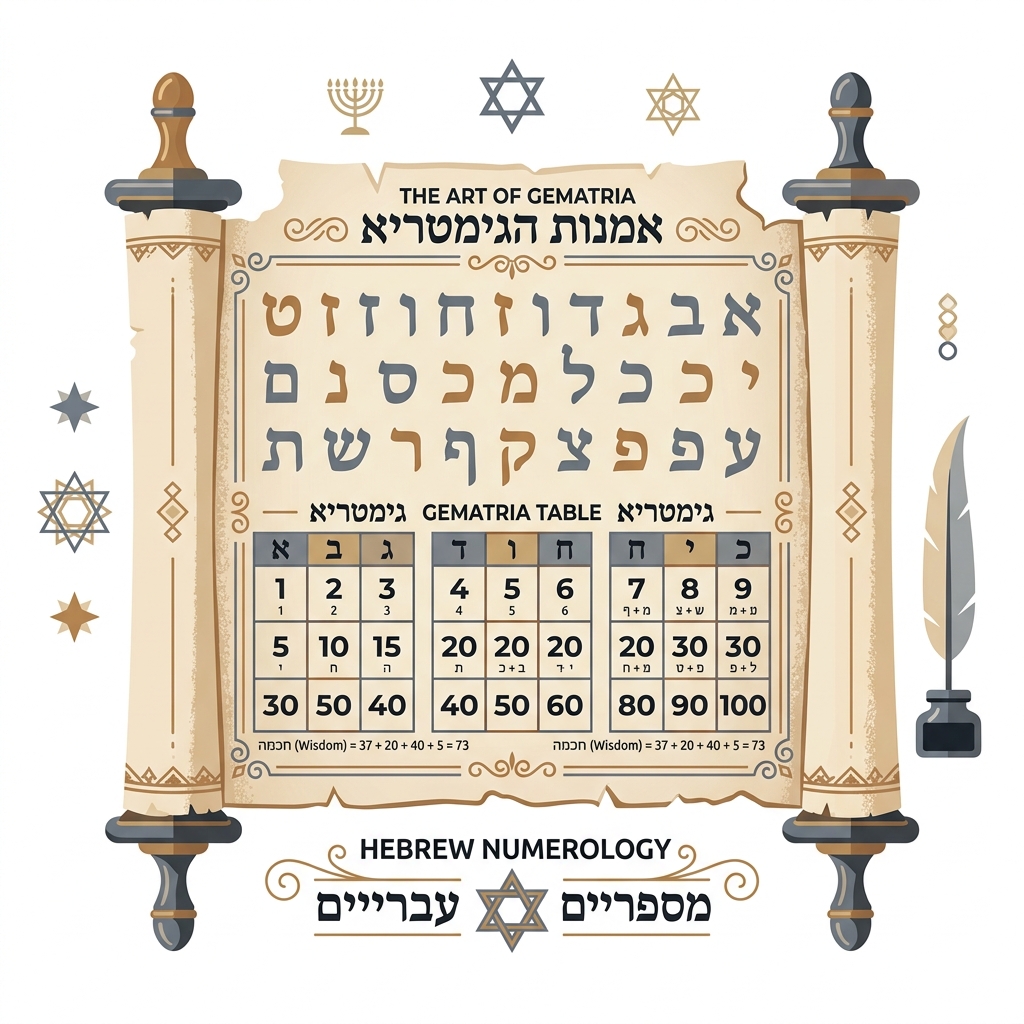
Have you ever wondered if letters and words carry secondary mathematical meanings? To explore this question, mystics and researchers look to the ancient science of gematria. But what is gematria exactly? In its simplest form, it is the practice of assigning specific numerical values to letters of an alphabet, allowing words and phrases to be converted into numbers. By comparing words that share the same mathematical sum, scholars explore hidden symbolic connections across historical literature and scriptures.
The Historical Roots of Alphanumeric Mappings
Historically, ancient writing systems (such as classical Hebrew, Greek, and Latin) did not have a separate set of symbols to represent numbers. Instead, alphabetical characters doubled as numeric markers. Because every word had a built-in mathematical value, reading a text meant interacting with both its narrative meaning and its arithmetic properties.
In Jewish mysticism, specifically the Kabbalah, gematria is treated as a major tool for textual interpretation. Scribes analyzed the Hebrew Torah by calculating names and phrases to discover matching sums. This alphanumeric practice soon spread across other writing systems, leading to the development of several distinct ciphers that are still used today.
Explaining the Core Gematria Ciphers
Modern translation systems make use of several standardized ciphers. If you are using a simple gematria calculator, you are interacting with the standard alphabetical index:
- Simple Cipher: Each letter corresponds directly to its numerical rank in the standard English alphabet (A=1, B=2, C=3, and so on up to Z=26).
- English Cipher: This cipher scales standard alphabetical positions by a multiplier of six (A=6, B=12, C=18... Z=156). Under this mapping, the word "COMPUTER" sums to exactly 666, which has historically generated significant interest among numerologists.
- Jewish Cipher: This cipher translates Latin letters to their traditional Hebrew alphabetic values. For instance, the letter 'J' equals 600, 'V' equals 700, and 'W' equals 900. It is widely used by researchers looking to check names against Biblical codes.
How to Use a Gematria Calculator Efficiently
Doing alphanumeric calculations by hand is slow and prone to errors. Fortunately, you don't need to memorize character tables. If you want to know how to use gematria calculator platforms, the steps are extremely straightforward:
- Find the best gematria calculator that calculates multiple ciphers in one step.
- Input your phrase or name in the search field.
- Trigger the calculation manually by clicking the "Decode" button or pressing Enter. This prevents laggy page recalculations.
- Review the totals and inspect the exact letter-by-letter summation breakdowns to verify how the math was computed.
Why Use Our Online Suite?
Many online tools are crowded with ads and tracking scripts. We offer the best gematria calculator free of cost and operates client-side, meaning we never track your inputs or save your queries. This is a secure, private, and high-fidelity tool designed for students, linguists, and researchers.